Laser Marking ID Plates: Metalcraft

- Home
- Resources
- Success Stories
- Metalcraft
When a nameplate has to stay legible through weather, chemicals, and years of abuse on equipment that lives outdoors, the marking method matters more than the metal under it. Metalcraft has built identification plates for harsh environments since the early 1990s, on stainless steel, aluminum, and plastic in anodized, painted, and galvanized finishes. After a competitive bid, they chose a Jimani fiber laser system — and six months later, when a flood destroyed the rest of their laser floor, the compact fiber unit was the only marker they could carry to safety. Here is why the system won the job, why it survived, and what it tells a buyer evaluating a benchtop fiber laser for ID plate work.
Why do ID nameplates for harsh environments need laser marking?
Quick Answer:
ID nameplates for harsh environments need laser marking because the mark has to survive weather, abrasion, solvents, and handling for the life of the equipment it identifies. A laser marks directly into the substrate or its finish, so there is nothing applied on top to peel, fade, or wash away.
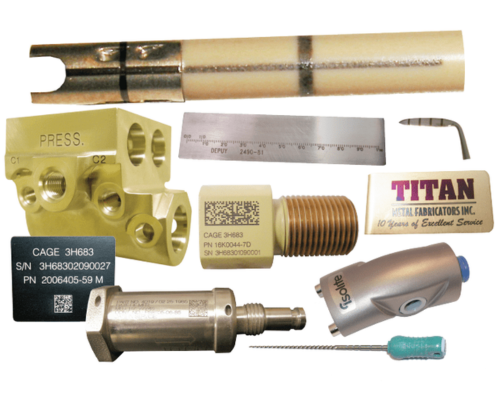
Metalcraft's plates go on equipment that lives in conditions most labels never survive. The plates are made from a mix of stainless steel, aluminum, and plastic, and many of those are anodized, painted, or galvanized before marking. Each of those surfaces behaves differently under a laser, which is the real challenge — one machine has to produce a clean, high-contrast, permanent mark across all of them.
On an anodized or painted plate, the right technique is usually ablation: the laser removes the coating to expose a contrasting substrate underneath, leaving a mark that is part of the plate rather than a layer sitting on it. On bare metal, the same system can produce a contrasting surface mark without adding inks or consumables. In our own job shop at Jimani, harsh-environment identification is one of the most common reasons a customer moves off printed labels and onto a laser in the first place.
How did Jimani win a competitive laser bid against several suppliers?
Quick Answer:
Jimani won the Metalcraft purchase order against several other suppliers on three things: the mark quality of the sample parts, the cycle time those samples ran at, and fair pricing on the system. The decision came down to demonstrated results on Metalcraft's own materials, not a spec sheet.
Jimani met Metalcraft at a trade show in 2007, where both were exhibiting and Metalcraft mentioned they were in the market for an additional laser. What followed was a competitive bid against a number of other laser marking suppliers. The order came to Jimani because the samples marked cleanly, ran at a competitive cycle time, and the system was fairly priced.
That sequence is worth pausing on. The buyer did not award the order on the brochure. They sent parts, compared the marks and the speeds side by side, and bought the system that produced the best result on the materials they actually run. It is the same way we tell every prospect to evaluate a marker — send the parts and judge the output, because mark quality on your own substrate is the only specification that matters in the end.
Why was the fiber laser the only marker Metalcraft could save in a flood?
Quick Answer:
The Jimani fiber laser was the only marker Metalcraft could save because it was small and self-contained enough to carry to a second floor above the rising water. Their larger YAG and diode-pumped systems were immobile — tied to external cooling and heavy enclosures — and the flood destroyed them.
About six months after the first system was installed and running, Metalcraft's plant in Mason City, Iowa was hit by catastrophic flooding, and the ground floor where the lasers sat went underwater. Staff were able to move the compact Jimani fiber system up to the second floor, above the water line. The plant's larger, immobile YAG and diode-pumped laser systems could not be moved and were lost.
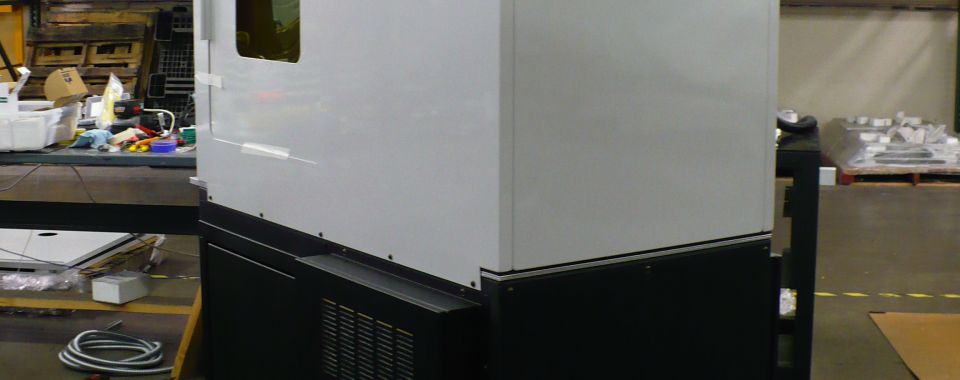
The reason comes down to what a fiber laser does not need. A fiber laser module is sealed and air-cooled, so the whole marker is a benchtop-scale unit with no external chiller, no water loop, and no large floor cabinet anchoring it in place. A water-cooled YAG or diode-pumped system is a different animal — heavy, plumbed to a cooling system, and effectively bolted to the floor it sits on. When water is rising, one of those you can pick up and carry. The other you leave behind.
How fast can a fiber laser system be replaced after a disaster?
Quick Answer:
Because Jimani stocks standard laser components, a replacement fiber laser marking system was built and on a truck to Metalcraft within two days of their call. Keeping core components on the shelf is a deliberate practice so a customer who is down can be running again in days, not weeks.
With the floor flooded and production stopped, Metalcraft called Jimani and asked how quickly a 20-watt fiber laser system could ship. Stocking standard components — lasers, scanheads, lenses, control boards — is a best practice precisely for this kind of moment, when a customer cannot wait out a manufacturing lead time. A new system was assembled, tested, and on a truck within two days.
For a manufacturer, that is the part of a vendor relationship you never think about until you need it. Equipment lead times on a laser module can run weeks, and a shop with a flooded floor and orders to fill does not have weeks. The ability to ship a complete, tested replacement in two days is a direct result of how Jimani carries inventory and builds systems in-house.
Why does a benchtop fiber laser fit a nameplate production floor?
Quick Answer:
A benchtop fiber laser fits a nameplate floor because it has a small footprint, runs on standard 115-volt single-phase power, needs no consumables or external cooling, and can be added one unit at a time as volume grows. A shop can scale capacity by adding identical stations rather than rebuilding around one large machine.
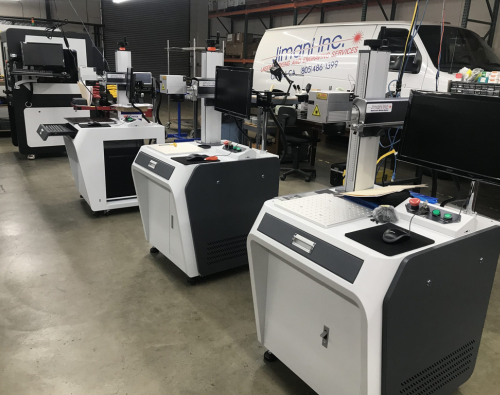
Metalcraft did not stop at one. The first system went in during 2007, and over the years that followed they added more, reaching six fiber laser installations on their floor. A benchtop fiber system makes that kind of incremental growth practical — each unit is self-contained, plugs into an ordinary outlet, and runs without the maintenance overhead of a flashlamp-based laser. Jim Miller, VP of Engineering at Metalcraft, summed up the arc:
"In 2007 we purchased our first Hybrid fiber laser. Now we are up to six installations powered exclusively by Hybrid fiber lasers. Jim Earman and his staff have worked hard to develop the right system for each application. Jimani has been a great partner in the success of Metalcraft's laser engraved products!"
Jim Miller — VP Engineering, Metalcraft
Six matched stations also means an operator trained on one is trained on all of them, fixtures move between machines, and a single unit going down does not halt the floor. That flexibility is part of why Hybrid fiber laser systems tend to multiply once a shop has the first one working.
Is a benchtop fiber laser the right choice for ID plate marking?
Quick Answer:
A benchtop fiber laser is the right choice for ID plate marking when the work spans metals and coated metals, needs permanent high-contrast marks, and runs at volumes that justify bringing marking in-house. For occasional or single-material runs, a laser job shop may be the better fit until volume catches up.
The Metalcraft case lines up cleanly with the in-house argument. A daily run of mixed-material plates, a permanence requirement on every one, and steady volume across multiple lines is exactly the profile that pays for the equipment — and then pays for five more. A shop marking the occasional plate, or one material at low volume, is usually better served outsourcing until the numbers shift.
If you make identification plates and want to know how a fiber laser will handle your specific materials and finishes, send us a sample. We will mark it in our job shop, show you the parameters and the cycle time, and walk through what a benchtop configuration looks like for your volume. If the math says outsource for now, we will tell you that too.
Interested in owning your own system

Interested in having us mark your product