Should You Outsource Laser Marking or Buy Your Own System?
You have parts that need a permanent mark and a decision to make: send them out to a laser job shop...
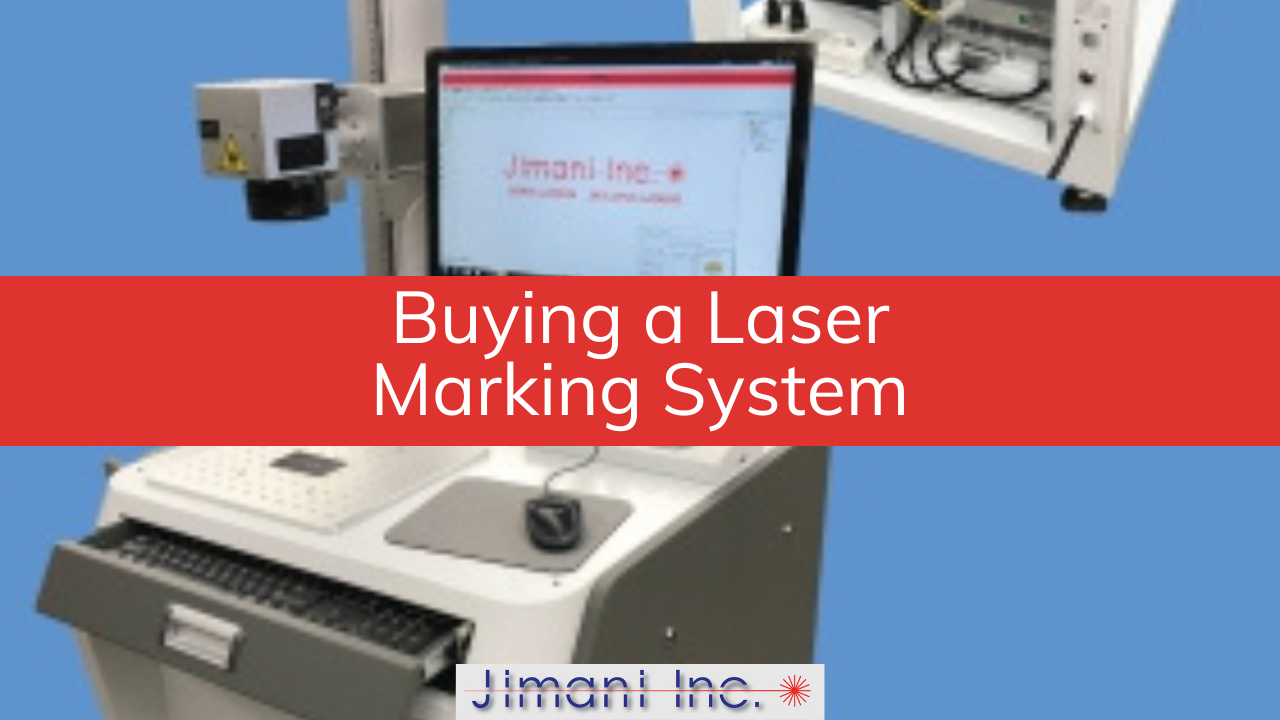
Buying a laser marking system represents a significant capital investment. For manufacturing engineers evaluating technical requirements and operations managers building the business case, the decision involves more than comparing equipment specs. It requires honest assessment of your production reality, your marking requirements, and whether ownership makes sense for your specific situation.
The question most prospects wrestle with isn't whether laser marking is the right technology. They already know it is. The real question is whether they have enough volume to justify bringing that capability in-house.
Before evaluating laser systems, step back and ask whether buying makes sense at all. Jimani operates both sides of this equation—we sell laser marking systems and we run a contract marking job shop. That dual perspective has taught us that ownership isn't always the right answer.
Job shop services often make more sense when marking requirements are sporadic or low-volume. If you're marking a few hundred parts per quarter with long gaps between orders, the math rarely favors equipment ownership. You're paying for a machine that sits idle most of the time while still carrying maintenance responsibilities and floor space costs.
Personnel considerations matter too. Do you have someone on staff who can operate and maintain a laser system? If not, you're looking at either hiring for that role or pulling existing team members away from other responsibilities for training. That opportunity cost is real, even if it doesn't show up on a purchase order.
The calculus shifts when certain conditions are present in your operation.
Shipping costs can tip the scales quickly. Large, fragile, or heavy parts carry significant freight expenses, and those costs compound with frequency. If you're shipping parts out for marking monthly or weekly, those logistics expenses add up fast. A customer shipping automotive components to our job shop recently calculated their annual freight costs exceeded what they would have paid for a desktop Hybrid laser system within 18 months.
Production timing is another factor. When laser marking sits in the middle of your manufacturing flow, sending parts off-site creates bottlenecks. Your production schedule becomes dependent on someone else's capacity and turnaround time. Bringing marking in-house eliminates that dependency and gives you control over your workflow.
Quality control concerns also drive the ownership decision. Some manufacturers need to maintain chain of custody on their parts or require marking verification before the next production step. Outsourcing introduces handling by third parties and potential quality variance that in-house operations eliminate.
There's no universal volume number that makes the case for every application. The calculation depends on what you're marking, how complex the marking is, and what you're currently paying for outsourced services or alternative marking methods.
That said, we've seen patterns over 40 years in this business. Manufacturers running consistent marking requirements—even at moderate volumes of a few thousand parts per month—often reach payback within 12 to 18 months when replacing manual marking methods, labels, or outsourced services.
The more useful question isn't "do I mark enough parts?" but rather "what am I paying now, and what would I pay with an in-house system?" Factor in your current per-part marking costs, shipping to and from a job shop if applicable, the labor involved in your current process, and the downtime created by waiting for outsourced work to return. Compare that against equipment cost, operating expenses (which are minimal for fiber lasers), and the labor to run the system.
Once you've determined that ownership makes sense, the next step is understanding your application requirements well enough to have productive conversations with equipment vendors. Coming to those discussions prepared saves time and helps you get accurate pricing.
Know your materials. The substrate you're marking determines the type of laser you need. Fiber lasers handle all metals—bare, coated, anodized, or plated—along with many plastics. We also offer CO2 laser systems for those applications not suited to fiber lasers. Please reach out and our team will help you understand which system is the best for your particular application.