Laser Marking for Bioprocess/Pharmaceutical Instrumentation: Broadley James Corporation

- Home
- Resources
- Success Stories
- Broadley-James Corp.
When a sensor manufacturer needs to put a permanent, legible mark on brass, stainless steel, and plastic parts every day — and has never owned a laser — the question is whether one system can handle all three materials without becoming a maintenance project. Broadley-James Corporation, a Southern California manufacturer of sensors and instrumentation for the bioprocess and pharmaceutical industries, answered that question by purchasing a Jimani 20-watt fiber laser system. The day after delivery, they were marking production parts. This is how that worked, what the system handles, and what other manufacturers facing the same decision should know before they buy.
Why does bioprocess instrumentation need permanent direct part marking?
Quick Answer:
Bioprocess and pharmaceutical instruments require permanent direct part marking because labels, ink, and adhesive stickers cannot survive the cleaning, sterilization, and chemical exposures these parts encounter. Manufacturers depend on legible part identification for inventory control, internal traceability, and process management across the product life cycle.
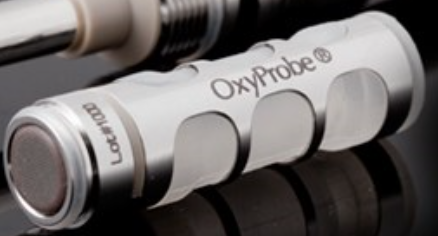
Sensors, fittings, and instrument bodies used in bioprocess applications routinely see steam, caustic cleaning chemicals, solvents, and repeated handling. Anything applied to the surface — adhesive labels, printed inks, dot-peen marks filled with paint — degrades or disappears under those conditions. When a serial number vanishes mid-process, the part loses its history, and the manufacturer loses traceability.
Direct part marking solves that problem at the source. A laser ablates or engraves directly into the substrate, leaving a mark that is part of the part itself. The mark survives every process the part will see, which is the only reason it gets specified in the first place. Broadley-James needed that level of permanence across a mixed inventory of brass, stainless steel, and plastic components, and they needed it consistently enough to run on every part, every shift.
In our job shop experience at Jimani, the driving requirement for sensor, medical device, and pharmaceutical instrumentation manufacturers is rarely cosmetic. It is the inability of any non-laser marking method to survive the downstream environment.
How does one fiber laser system mark brass, stainless steel, and plastic?
Quick Answer:
A single 1064 nm fiber laser marks brass, stainless steel, and many plastics because all metals absorb the 1064 nm wavelength and produce ablation or engraving marks, and many engineering plastics respond to the same wavelength with adjusted parameters. The operator changes laser power, pulse frequency, and marking speed for each material — not the equipment.
The wavelength is what makes a fiber laser versatile across mixed-material workflows. At 1064 nm, the laser energy is absorbed by every metal we have ever put under a fiber system. Brass gives a clean, contrasting mark with light ablation. Stainless steel can be marked three ways — ablation for a contrast mark, stain marking for a dark non-penetrating oxide, or engraving for depth — depending on what the part needs.
Plastics are more selective. Some engineering plastics absorb 1064 nm energy well and produce a clean, high-contrast mark. Others do not, or they melt rather than mark. The honest answer is that some plastic substrates need a CO2 laser, and we tell customers that when it comes up. For the plastics Broadley-James was running, the fiber system handled them with parameter adjustments — typically lower power and faster marking speed than the metals require.
The operator skill that matters is not learning a new piece of equipment for each material. It is learning the relationship between speed, power, and pulse frequency for the materials in the production mix. Once that relationship is dialed in for a given part, the recipe is saved in the marking software and recalled every time that part runs.
Can a manufacturer with no laser experience get a fiber laser running quickly?
Quick Answer:
A properly turnkey fiber laser system can be unpacked, plugged into a standard 115-volt outlet, and marking production parts within a day of delivery, even for an operator with no prior laser experience. The system arrives calibrated, with the marking software installed and the laser, scanhead, and lens configured for the customer's application.
Broadley-James had no laser background when they decided to bring marking in-house. That is closer to the rule than the exception. Most manufacturers buying a first fiber laser system are doing it because they have outgrown stickers, stamps, or an inkjet that keeps wandering off-spec.
The system Broadley-James purchased shipped fully assembled, tested, and burned in. It runs on standard 115 VAC, 15-amp service — the same outlet that powers a coffee maker. Dan Folwell, General Manager at Broadley-James, described the experience this way:
“We purchased our Jimani fiber laser marking system over a year ago, and I have nothing but good things to say about the product. The fiber laser system truly is a turn-key system. The day after we received the unit, we had it unpacked, set up, plugged into a standard 115 Volt wall outlet and were marking our first sample parts. The system is a work horse. Since we received it, we’ve been marking stainless steel, brass and plastic parts almost every day with no problems and no maintenance. This system has become an important and valuable addition to our manufacturing capabilities.”
The day-after-delivery timeline is not a marketing claim. It is what happens when a system is fully integrated and calibrated before it leaves Oxnard, and when the customer has spent a day of training at the factory before the shipment goes out.
What software and file formats does a fiber laser system need to support?
Quick Answer:
A production-ready fiber laser system needs marking software that handles industry-standard machine-readable codes (2D Data Matrix, UID, UPC, Code 39), human-readable text and serial numbers, common vector graphics formats (.dxf, .plt, .dwg, .ai, .eps), and raster image formats (.bmp, .jpeg, .png, .tif). Without that file flexibility, the production manager spends more time fighting the software than marking parts.
The Broadley-James system shipped with Prolase marking software installed and pre-loaded with the bar code symbologies and font sets a sensor manufacturer is going to need. The reason that matters is simple: a marking system that cannot accept the customer’s existing artwork or label files creates a second job — redrawing every part number, every logo, every code — before the laser can do anything useful.
Prolase laser marking software, the package Jimani ships with most systems, is built by American Laserware specifically for laser marking. That focus shows in the file format handling, the rotary and tiling features, and the support response when something needs attention. Jimani also offers Leopardmark as a lower-cost option that retains the core feature set for users who do not need the Prolase Plus tooling.
When evaluating a fiber laser system, the file-format and code-symbology coverage in the software is worth as much scrutiny as the laser power rating. It is the difference between a marking station and a marking project.
What kind of ongoing support do new laser owners actually need?
Quick Answer:
Most ongoing support for fiber laser owners is application support — figuring out how to mark a new material, set up a new fixture, or refine parameters for a difficult part. Hardware support is rare because fiber lasers have no consumables, no user-serviceable parts, and operate for tens of thousands of hours without power degradation.
This is one of the genuine advantages of fiber lasers over older YAG systems. There are no flashlamps to replace, no laser rods to reseat, no coolant loop to maintain. The fiber laser module is sealed and air-cooled. From the customer’s side, the predictable cost is electricity and the occasional focusing-lens cleaning. That is it.
What customers do need — and what Broadley-James used — is help dialing in parameters on a new material or working through a new fixturing challenge. Dan Folwell described the support arc this way:
“I would recommend taking advantage of the ½ day of training included with the purchase. My production manager and I visited the Jimani facility in Oxnard for the training, and left about eight hours later with samples engraved on the system we were going to purchase, and a thorough understanding of the equipment and how to use it. The technical support has been great. Jim and his team are very knowledgeable, not only about this system, but laser systems in general, and so far, Jim has always been just a quick phone call or e-mail away. I wouldn’t hesitate recommending the fiber laser system to anyone in the market for this type of laser marking system.”
The training is included with every system. The phone and email support is unlimited and at no charge for both Prolase and Leopardmark. We do that because the application questions are interesting, and because a customer who understands their equipment runs better parts.
Is in-house fiber laser marking the right call for a bioprocess manufacturer?
Quick Answer:
In-house fiber laser marking makes sense for a bioprocess or pharmaceutical instrument manufacturer when parts are marked frequently across multiple materials, when traceability is a regulatory or contractual requirement rather than a preference, and when the cost or lead time of outsourcing is creating bottlenecks in production. For low-volume or one-off marking, a laser job shop is often the better fit.
The decision criteria are not subtle. A manufacturer running mixed-material parts every day, with a traceability requirement attached to each one, will usually justify the equipment in the first year. A manufacturer marking a handful of prototype parts a month is better served by sending them to a job shop. Broadley-James sat firmly in the first category, which is why the fiber laser system has been marking parts almost every day since it arrived.
If you are working through the same decision and want a straight answer on whether your part mix justifies in-house equipment, the fastest way to find out is to send us a sample. We will mark it in our job shop, share the parameters we used, and walk through what an in-house configuration would look like for your volume. If outsourcing is the better answer, we will tell you that too — and keep marking your parts in the job shop until the math changes.
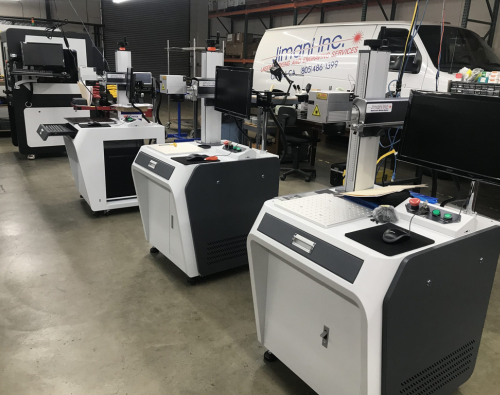
Interested in owning your own system

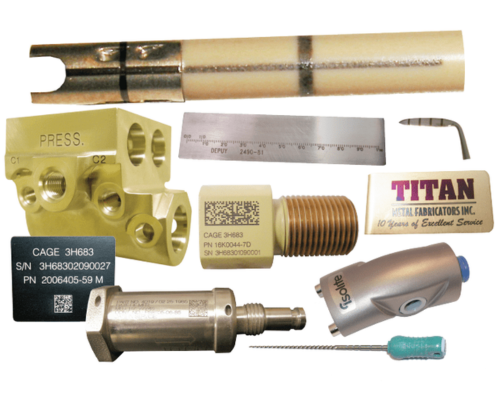
Interested in having us mark your product