
Laser Marking for Firearms: Smith & Wesson

A firearms manufacturer cannot ship a part until it carries a permanent, legible, regulation-depth mark — and when a difficult new material will not take that mark cleanly, production stops. Smith & Wesson, the firearms maker in Springfield, Massachusetts, ran into exactly that on a set of difficult plastic components and looked outside for help. Jimani won the work on sample results its competitors could not match, and what started as one machine for one hard material became a standard across the floor. Here is why firearms get laser marked in the first place, why those plastics were so stubborn, and what made the systems multiply once the first one was running.
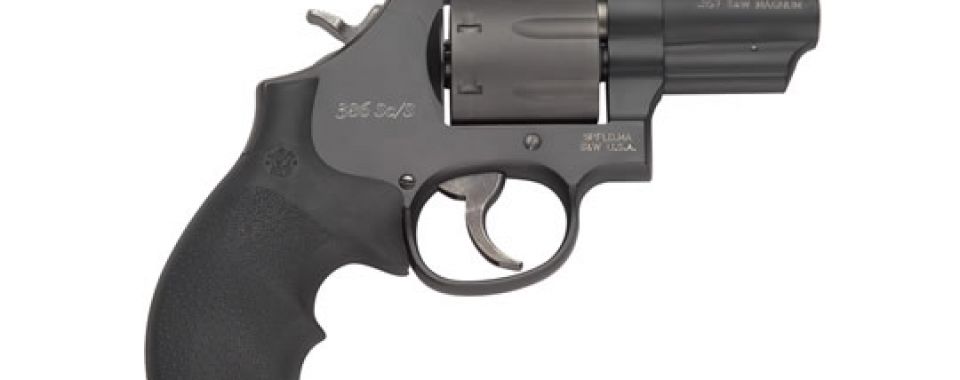
Why are firearms laser marked for ATF compliance?
Quick Answer
Firearms are laser marked to satisfy ATF and other regulations for item-level traceability and part identification. The serial number and required markings have to be permanent and meet a minimum engraving depth so they cannot be easily removed, which is why a depth-capable process like fiber laser engraving fits the requirement.
Item-level traceability is not optional in this industry. Every firearm carries identifying information that ties it back to its maker, and federal rules require that marking be permanent and deep enough to resist removal. That last point is what rules out a light surface mark for the serialized information — the regulation effectively specifies a minimum depth, so the process has to cut into the material, not just discolor it.
That depth requirement is one of the clearest cases where laser marking firearms means engraving rather than a shallow surface mark. A fiber laser can hold a tight, legible character at a controlled depth across a production run, which is exactly what a compliance mark needs. Smith & Wesson uses laser markers across its operation for that traceability and part identification.
Why are some plastics difficult to laser mark?
Quick Answer
Some plastics are difficult to laser mark because they absorb laser energy unevenly and melt or distort before a clean, high-contrast mark forms. Getting a good mark depends on controlling pulse width, power, and speed so the laser marks the surface without overheating the material.
Metals are forgiving by comparison. Many engineering plastics are not — apply too much power for too long and the surface melts or chars instead of producing a crisp, readable mark. The window between "no mark" and "melted" can be narrow, and it moves from one polymer formulation to the next, which is why a material that marks fine on one system can defeat another.
The tool that opens that window is a variable pulse width MOPA fiber laser. Shortening the pulse and lowering the average power lets the laser mark the surface in very brief bursts of energy, leaving a clean mark before heat has time to build up and deform the plastic. Dialing that in is a parameter problem, not a different machine — but it takes someone who has worked the relationship between pulse width, power, and speed to find the setting that holds across a production run.
How did Jimani win the job on samples when other suppliers couldn't?
Quick Answer
Jimani won on demonstrated sample results. On the difficult plastic materials, Jimani produced cycle time and mark quality that Smith & Wesson could not achieve on its own equipment and that the other laser suppliers' samples did not match. The decision came from marked parts, not specifications.
Smith & Wesson brought the problem to several laser system suppliers at once and judged them on the same thing that matters on the floor: how clean the mark was and how fast it ran. Jimani's samples came back better on both counts than the in-house attempts and the competing suppliers' results. That is the entire case — not a brochure claim, a side-by-side comparison on the customer's own difficult material.
It is the way we tell every prospect to evaluate a marker, and the reason our standing offer is to mark your parts in our own job shop before you commit to anything. Mark quality on your specific material is the only specification that settles the question.
Why do wall-powered, stand-alone fiber lasers improve production flow?
Quick Answer
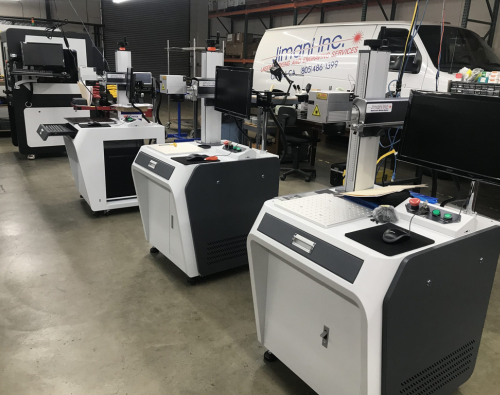
Wall-powered, stand-alone fiber lasers improve production flow because they run on standard single-phase outlets with no external cooling or facility infrastructure, so a marking station can be moved and a work cell reorganized without shutting down production. The system goes where the work is, instead of the work routing around the system.
A fiber laser module is sealed and air-cooled, so the whole marker is a self-contained unit that plugs into an ordinary wall circuit. There is no chiller, no water loop, no three-phase drop to plan around. For a plant that is constantly tuning its layout, that changes what is possible — a marking station becomes a piece of equipment you can relocate to optimize product flow, not a fixed installation everything else has to accommodate.
Smith & Wesson put real weight on this. Their systems are standard wall-powered units, and the ability to reconfigure work cells around them, rather than the reverse, is one of the advantages they call out directly in the section below.
What has kept Smith & Wesson buying from Jimani over the years?
Quick Answer
What started as one system for one difficult material became a repeat relationship because the systems proved reliable in high production and the support carried each new application from R&D into production cleanly. As new marking requirements came up, Smith & Wesson kept adding Jimani systems.
The first machine was bought for those stubborn plastics. It worked well enough across the rest of Smith & Wesson's materials that more followed as new requirements appeared, with Jimani supporting a range of marking and engraving processes along the way. Dave Simard, Capital Program Manager at Smith & Wesson, summed up the relationship:
"Smith & Wesson has purchased laser systems from Jimani Inc. for a number of different applications over the past few years. The Hybrid fiber laser marking systems have proven themselves to be reliable, easy to use and easy to maintain in high production applications.
These wall powered 110v stand alone systems provide mobility and flexibility that we previously thought would be impossible to achieve. This has allowed us to optimize work cell layouts on the fly to improve product flow without interrupting production.
Beyond the quality of each system and its hardware it is the dedication and personal service to provide true turnkey systems on-time which sets Jimani apart from the rest. Jim Earman's extensive hands-on laser experience gives him the ability to quickly provide custom programs and settings optimized for each application with clean and clear results.
In addition, his relaxed approach to on-site training and his unique ability to teach both operators and technicians in simple down to earth terms has made each transition from R&D into production happen with ease. Jimani has continued to exceed our expectations in product quality, technical assistance and ongoing service."
Dave Simard — Capital Program Manager, Smith & Wesson
The throughline is that the hardware got Jimani in the door, and the applications work kept it there. A system that arrives with the programs and settings already proven, and an operator trained in plain terms, is what turns a capital purchase into production capacity quickly.
Is a fiber laser the right fit for firearms or other regulated marking?
Quick Answer
A fiber laser is a strong fit for firearms and other regulated marking when the requirement is a permanent, depth-controlled mark applied consistently across production, on metals or difficult plastics. The process holds a legible mark at a specified depth and adapts to mixed materials through parameter changes rather than new equipment.
Regulated marking has two demands that work against each other: the mark has to be permanent and deep enough to satisfy the rule, and it has to run fast and consistently enough to keep up with production. A fiber laser handles both, and it covers the awkward case — a line of products that mixes metal and difficult plastic — on one system with material-specific recipes. For firearms makers specifically, the depth control is what makes it a compliance tool, not just a marking tool.
If you have a regulated marking requirement and a material that is fighting you, send us a sample. We will mark it in our job shop, show you the cycle time and the parameters, and tell you straight whether a Hybrid fiber laser system fits your application — or whether you are better off having us mark the parts for you while the volume builds.
Interested in owning your own system

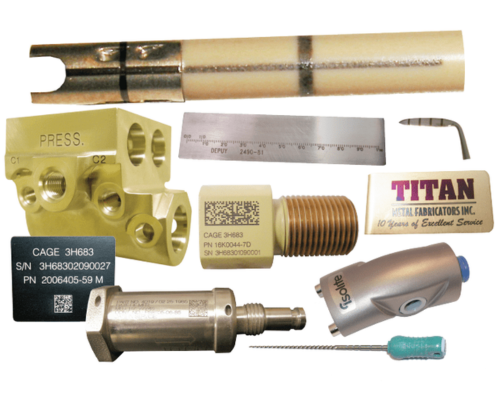
Interested in having us mark your product