Laser Marking Stainless Steel Goes Down Smooth
Industry: Flask

A polished stainless steel platter is an unforgiving marking surface: every detail has to stand out without damaging the mirror finish. This job shows how Jimani used one fiber laser setup to create a two-tone logo with a deep engraved outline and a bright white surface mark on the same decorative stainless part.
Quick Answer
Yes — a fiber laser can create a two-tone logo on polished stainless steel by using two different laser parameter sets on the same part. On this 18-inch platter, Jimani engraved the logo outline deep into the stainless steel and surface marked the fill so it reads white against the polished mirror finish.
Industry: Automotive Aftermarket
Part Type: 18" diameter platter
Material: Polished Stainless Steel
Mark Data Type: Logo
Laser Mark Type: Deep laser engraving (outline) plus surface marking (white fill)
Here's a marking job most shops would split across two processes: a logo that needs to read as a crisp, deep-engraved outline with a bright white fill inside it — on a mirror-polished 18-inch stainless steel platter. A single fiber laser handled both. The outline was cut as a deep engraving, the white was produced as a surface mark, and the two looks came from running two different sets of laser parameters on the same part. Below is how a fiber laser puts two finishes on one stainless surface, why the white look works the way it does on polished metal, and what kind of system handles a part this size.
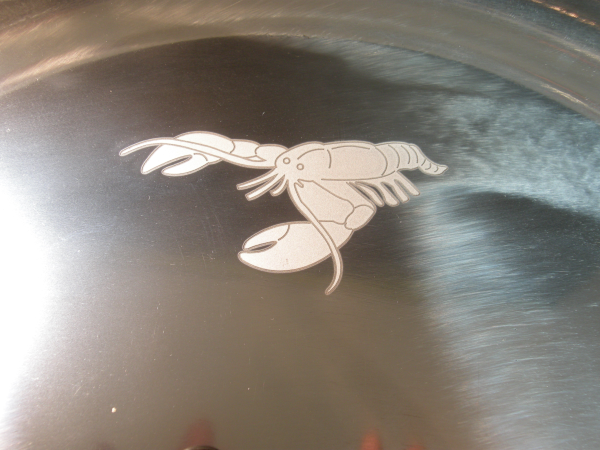
The two finishes come from changing how hard and how fast the laser works the surface. The deep outline calls for higher power and slower marking speeds with multiple passes, removing material to cut the line down into the steel. The white fill calls for the opposite — faster speed and lighter power that texture the surface rather than dig into it. The logo art stays the same. What changes is the marking recipe applied to each element.
Doing this in one setup matters. The part isn't moved or re-fixtured between the engraved outline and the white fill, so the two elements register to each other exactly as drawn. The mark on this platter stands about 3 inches high, and the outline and fill line up because they were marked from the same file in the same position.
Combining techniques on one part is routine in our job shop — most of the value comes from knowing which parameter set produces which look on a given material, not from owning some special piece of hardware.
Polished stainless reflects light like a mirror, which is why an untreated surface looks bright and metallic. When the laser textures that surface with light, fast passes, it breaks up the reflection. Light hitting the textured area scatters in many directions rather than reflecting cleanly, and the result reads as a frosted white against the polished background. This is the ablation family of marking — surface-level, measured in microns, with no meaningful penetration into the part.
It's worth keeping the techniques straight, because their names get used interchangeably and they are not the same thing. Stain marking — sometimes called annealing — heats stainless to grow a dark oxide layer and produces the opposite effect: a dark mark, not a white one. The white fill on this logo is a surface texture, the dark a different process entirely, and the deep outline is material removal. Three behaviors, one laser, three sets of parameters. You can see how these processes differ on our laser marking and engraving services page.
On a coated or matte material, a mark has some natural contrast to work with. A mirror finish gives you none of that — the mark has to create its own contrast by changing how the surface handles light. That's why the white fill works only inside a fairly narrow window of speed, power, and pulse settings. Drift outside it and the white either washes out against the shine or tips over into a heat-discolored haze that the customer didn't ask for.
The deep outline has its own constraint. Engraving into stainless removes material and leaves a trough, and pushing too aggressively in a single pass leaves a slaggy bottom and slag along the edges. Cleaner results come from multiple passes at moderate speed, taking off thin layers until the line reaches depth. Dialing in both finishes on the same polished surface — bright white in one area, clean engraving in another — is the kind of setup work that separates a logo that looks intentional from one that looks like an accident.
The lens choice drives the geometry. A 254 mm lens gives a larger marking field, which is what lets a roughly 3-inch logo land cleanly on a big platter, but a larger field also means the lens has to sit farther from the part to keep focus. The bigger the field, the more working distance you need below the optics — and that's where Z-axis travel earns its keep. An open-table workstation with long Z adjustment places the focusing lens well above the marking surface, so it accommodates long focal length lenses, parts fixtures, and large or tall parts without forcing you to cut down the job.
The system is self-contained. The industry-standard 19-inch rack-mount computer and the fiber laser controller live inside the workstation frame, so the whole unit runs from a single 115 VAC household outlet with no water lines or high-voltage hookups to tie it down. Mounted on casters, it can be rolled to another work area when a job calls for it. The marking software is Prolase, the package Jimani runs on every system it builds and uses.
Jimani uses lasers and Jimani builds lasers, and a part like this platter is where that shows — the parameter sets that produced the engraved outline and the white fill came straight out of job shop experience, not a spec sheet.
If you've got a polished or decorative part and you're not sure a laser can give you the contrast or the two-tone look you want, send us a sample and we'll mark it. Working out the right parameters for a tricky surface is exactly what we do every week in the job shop. Browse our fiber laser marking systems to see the available configurations, or send a part and we'll show you the mark before you commit to anything.