Laser Marking Round Parts: What Manufacturing Engineers Need to Know
Round and cylindrical parts create unique challenges for laser marking. Unlike flat surfaces where...
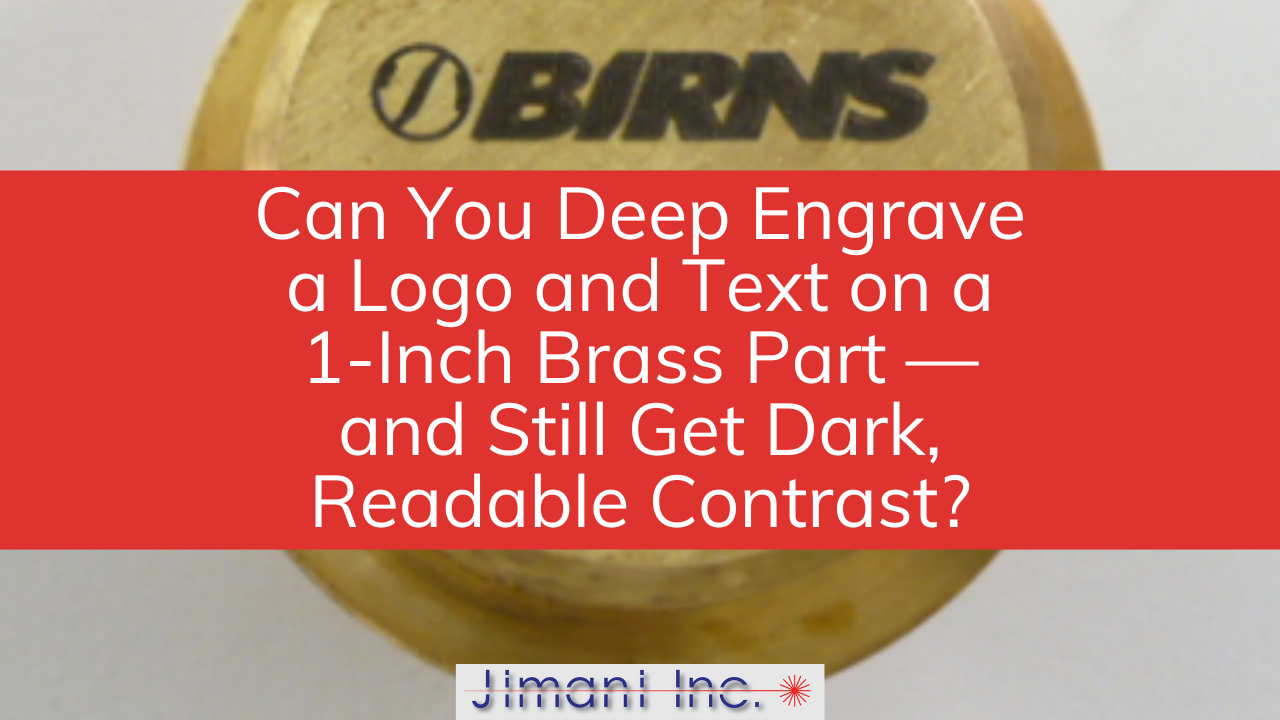
A small-diameter brass cover for an underwater light needed a permanent text and logo mark that could survive a harsh environment. No coatings. No secondary processing. Just a clean, dark engraving into free-machining brass. Here's how we approached it.
Brass 360 is one of the most machinable metals out there, which is exactly why it's a go-to for precision components like this underwater light cover. But free-machining alloys can behave unpredictably under a fiber laser. The high copper content affects how the material absorbs 1064 nm laser light, and at higher energy densities, you can end up with a rough, reflective trough instead of the clean, dark mark a demanding application requires.
The goal here wasn't just depth — it was dark, readable contrast on a small-diameter surface. That combination demands careful parameter selection. Too much power applied too slowly and you get slag buildup and ragged edges. Too many passes at the wrong fill angle and the bottom of the engraving becomes inconsistent. We've worked through enough brass jobs in the job shop to know where the failure points are.
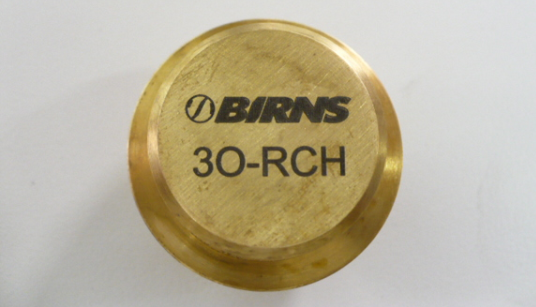
Brass 360 underwater light cover — text and logo deep-engraved using a 20-watt Jimani Hybrid fiber laser with dark mark parameters. No secondary processing required.
We marked these parts on a Jimani Hybrid Class IV open-table fiber laser using a 20-watt laser source. For the optical configuration, we selected a 254mm focal length lens, which delivers a 7.2 x 7.2 inch marking field. That field size is well-suited for a 1-inch diameter part — the focused spot is tight enough to hold fine detail without sacrificing power density.
The marking was done using what we call "dark mark" laser parameters. This approach uses multiple passes at moderate speed rather than trying to remove material aggressively in a single pass. In our experience with deep laser engraving, 5 to 10 inches per second with multiple passes at varying fill angles consistently outperforms slower single-pass approaches. Slow single passes tend to create a slaggy bottom in the engraving trough and push material to the edges. Rotating the fill angle between passes cleans that up and allows deeper, more uniform material removal with each successive layer.
| Parameter | Setting / Approach |
|---|---|
| Laser Source | 20-watt fiber laser (Jimani Hybrid) |
| Lens / Focal Length | 254mm EFL — 7.2 × 7.2 inch marking field |
| Mark Type | Text + logo — deep laser engraving |
| Technique | Multiple passes, rotating fill angles, moderate speed |
| Parameter Profile | "Dark mark" — optimized for contrast without post-processing |
| Post-Processing | None |
"No additional processing was required to achieve the dark contrast mark." That's not a given on bare brass — it's the result of dialing in the right parameter set for the material.
A 1-inch diameter part sounds straightforward to fixture, but precise location under the lens is non-negotiable when you're engraving a logo. A few thousandths of an inch of misalignment shows. The open-table design of the Jimani Hybrid workstation gives us the flexibility to build and position fixtures exactly where we need them without fighting an enclosure that limits access.
The Hybrid workstation provides up to 29 inches of Z-axis travel, meaning long focal-length lenses like the 254mm used here are fully accommodated without compromise. The system runs from a single 115 VAC outlet — no external cooling, no high-voltage connections, no water lines. That matters in a job shop environment where setup time and floor space both count. Mounted on casters, the system can be repositioned when the production floor demands it.
Marking software on the Hybrid system is Leopardmark — the American-made package we use and support directly. For applications that require rotary indexing, linear tiling, or multi-axis motion control, we also offer Prolase 10 as an upgrade. For this brass cover application, the job was straightforward enough that the standard configuration handled everything cleanly.
Deep laser engraving makes sense when the marked surface is subject to wear, when color-filling is part of the spec, or when permanence requirements make ablation-depth marking insufficient. For parts that need to survive handling, cleaning, or submersion — like this underwater light cover — engraving depth is what makes the mark last.
If you have a brass, steel, aluminum, or other metal component that needs a permanent deep-engraved mark, send us a sample. We run an active job shop using the same Hybrid systems we sell, which means we're testing parameters and refining techniques on real production parts every day. That hands-on experience is what makes the difference between a mark that looks good in a photo and one that holds up in the field.
Ready to see what a Jimani Hybrid fiber laser can do with your parts? Whether you need job shop marking services or want to evaluate a system for in-house production, we're happy to start with a sample.