
Ablation vs. Engraving vs. Stain Marking
Ask three shops to "engrave" a part and you may get three different processes. Fiber lasers mark...
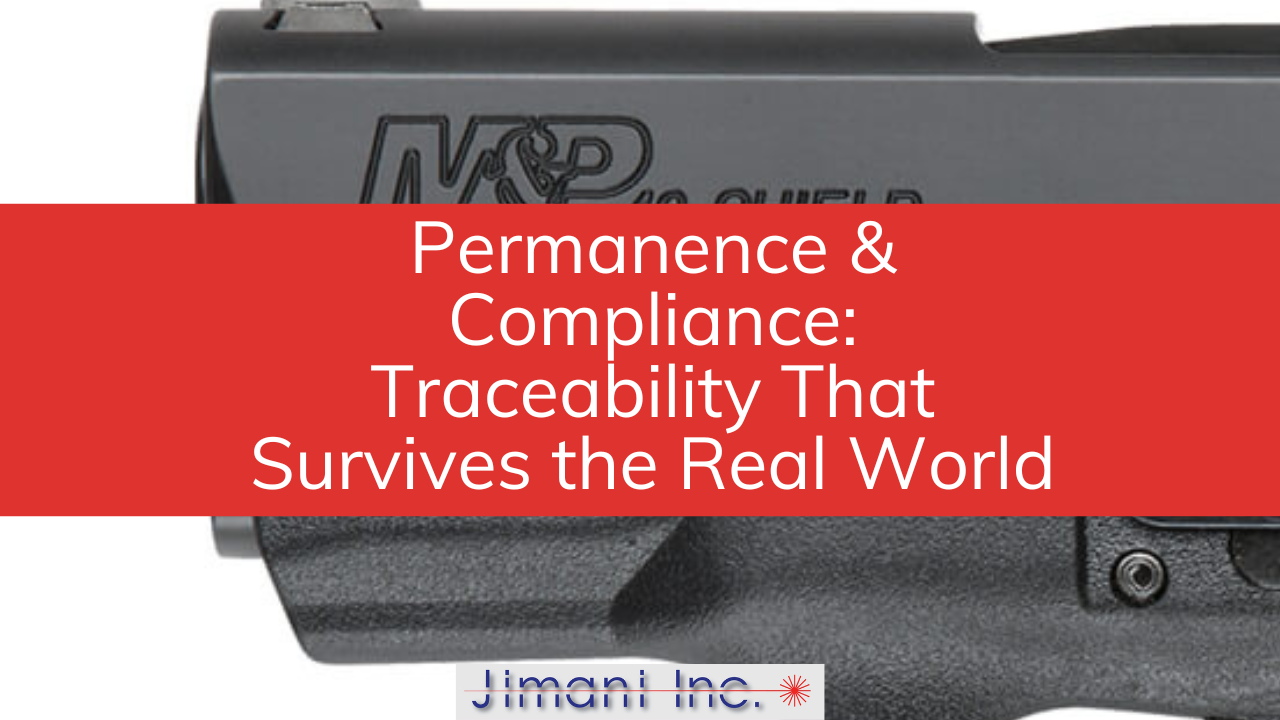
An auditor asks for traceability documentation on a batch of medical instruments shipped eight months ago. A field technician scans a 2D code on an aerospace fitting in a poorly lit maintenance bay. A firearm manufacturer needs to prove that a serial number applied last year is still legible and at the required depth.
In every one of these cases, the mark either holds up or it doesn't — and if it doesn't, the problem lands squarely on whoever applied it.
This is what traceability actually means in manufacturing. Not a label. Not a sticker. A permanent, machine-readable mark that survives whatever the part encounters between the production floor and the point of inspection. Fiber laser marking is well suited to that requirement — but only when the mark is designed and applied with the downstream reality in mind.
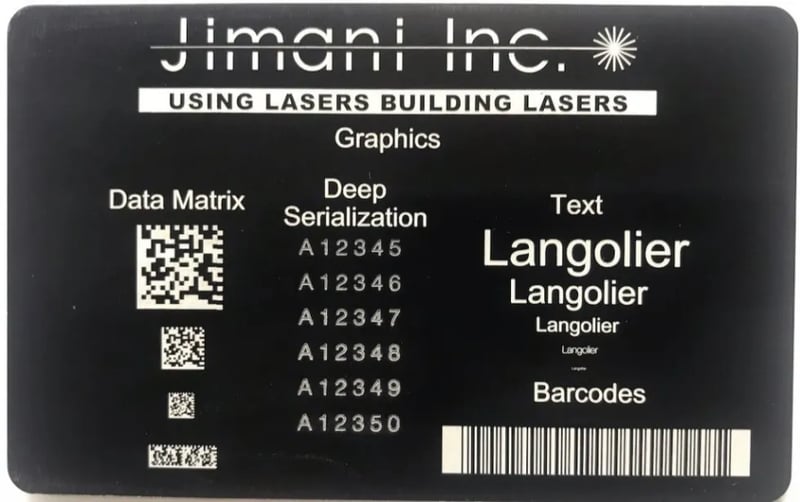
The term gets used loosely, so it's worth being precise. Traceability at the part level typically means one or more of the following: a unique serial number tied to a specific unit, a lot or batch code that links a group of parts to a production run, or a machine-readable symbol — most commonly a 2D Data Matrix code or a 1D barcode — that encodes that information in a format scanners can process reliably.
UID (Unique Item Identification) requirements in defense and government contracting, and UDI (Unique Device Identification) requirements in medical devices, are structured versions of that same concept. Both mandate that individual items carry a permanent, human-readable and machine-readable identifier that follows the part through its entire lifecycle. The formatting standards differ — MIL-STD-130 governs UID, while the FDA's UDI rule governs medical devices — but the underlying demand is the same: the mark has to be there, it has to be readable, and it has to last.
Fiber laser ablation and engraving both produce marks that satisfy permanence requirements, but they aren't interchangeable. Ablation removes a surface coating — anodize on aluminum, oxide on steel — and leaves a depth measured in microns. Engraving removes base material and creates a physical trough measured in thousandths of an inch. When a depth specification exists (as it does for most firearms serialization requirements), ablation alone won't meet it. Engraving at 5–10 inches per second with multiple passes gets you to the required depth cleanly. That distinction matters before you commit to a process, not after.
The honest answer is: it depends on what "lived its life" means for that specific part. A medical instrument goes through repeated autoclave cycles. An automotive component might see brake fluid, transmission oil, and road salt. An aerospace fastener could be subjected to anodize stripping and replating after it's been marked. None of those environments are friendly to surface-only marks.
Stain marking — the technique where the laser heats the metal surface to form a dark oxide layer without physically removing material — produces attractive, high-contrast marks on stainless steel and titanium. Penetration is measured in microns. The oxide layer is permanent under normal handling, but it can be sanded or abraded off. For parts that see wear surfaces or aggressive chemical exposure, stain marking is the wrong choice. A shallow engraved mark or an ablation mark followed by a protective coating is a better approach.
Engraved marks survive far more punishment precisely because the information is physically recessed into the part. Abrasion, solvents, and most surface treatments can't remove what's below the surface plane. At Jimani, when customers bring us parts destined for harsh environments, we routinely recommend a minimum engraving depth of .003" to .005" for general industrial use — deeper for defense or firearms applications where regulations specify it. Getting there without a slaggy, unreadable trough requires multiple passes at controlled speeds rather than trying to remove everything in a single slow pass. The quality of the finished mark reflects that patience.
This is where a lot of otherwise good laser marking work breaks down. A Data Matrix code can look perfectly clean to the naked eye and still fail a scanner read — not because the laser mark was bad, but because the code itself wasn't designed correctly for the material, the mark technique, or the scanner it will encounter downstream.
Three variables drive scanner performance: cell size, quiet zone, and print gain compensation. Cell size is the dimension of each individual cell in the Data Matrix grid. Too small, and the scanner can't resolve the cells reliably — especially on a curved surface or one with a brushed texture that scatters light unpredictably. A practical floor for laser-marked 2D codes on metal is a cell size of around .010" to .012" per cell for most industrial scanners, though the specific requirement varies with scanner type and reading distance.
The quiet zone is the blank border that surrounds the code. Scanners need that space to locate and decode the symbol. Cutting into it — even slightly — causes read failures that are maddening to diagnose because the mark looks complete. The quiet zone should be at least one cell width on all four sides, and two cell widths is a more reliable target.
Print gain (sometimes called mark growth) is the subtler problem. When a laser ablates material, the actual marked area is slightly larger than the programmed vector. The amount of gain varies with laser power, speed, spot size, and material. On a high-contrast surface like black anodized aluminum, the effect is minimal. On bare or lightly anodized aluminum, gain can close up the light cells in a Data Matrix enough to cause intermittent reads. The fix is straightforward: compensate in software by reducing the programmed fill dimension slightly, then verify readability under the same scanner and lighting conditions the code will see in production. At Jimani, we do that verification before a job ships. It takes a few minutes and prevents callbacks.
Verification is the part of this conversation that gets the least attention. Marking a part and verifying the mark are two different steps. Most manufacturing operations have a handheld barcode scanner sitting on the bench, and if it reads, the part passes. That's not verification — that's a basic functionality check. A scanner on a good day, at the right angle, with ideal lighting, will read codes that would fail a formal ISO/IEC 15415 grading evaluation.
If your application involves UID compliance, UDI submission to the FDA's GUDID database, or AS9132 requirements for aerospace DPM codes, a calibrated verifier that produces a grade report is part of the process. The ISO quality metrics — contrast, modulation, axial non-uniformity, unused error correction — tell you whether the code will read reliably across a range of scanners and conditions, not just the one you happen to have in front of you. That's the standard the auditor will apply. Applying it first is cheaper.
Laser marking is a reliable, permanent, and cost-effective way to meet traceability requirements across a wide range of industries and materials. But reliability requires that the process be set up correctly for the specific material, the specific mark type, and the specific downstream environment the part will encounter. The gap between a mark that was applied and a mark that performs is almost always a process design problem, not a laser capability problem.
We run a job shop here at Jimani, which means we've worked through these variables on a wide range of actual production parts — not just in theory. If you're evaluating a traceability requirement or trying to understand whether your current process will hold up under compliance scrutiny, send us a sample. We'll mark it and tell you exactly what we did and why.
Have a traceability application you're not sure about? Send us a sample part and we'll mark it, grade it, and walk you through the parameters. No commitment required — just straight answers. Contact Jimani here.